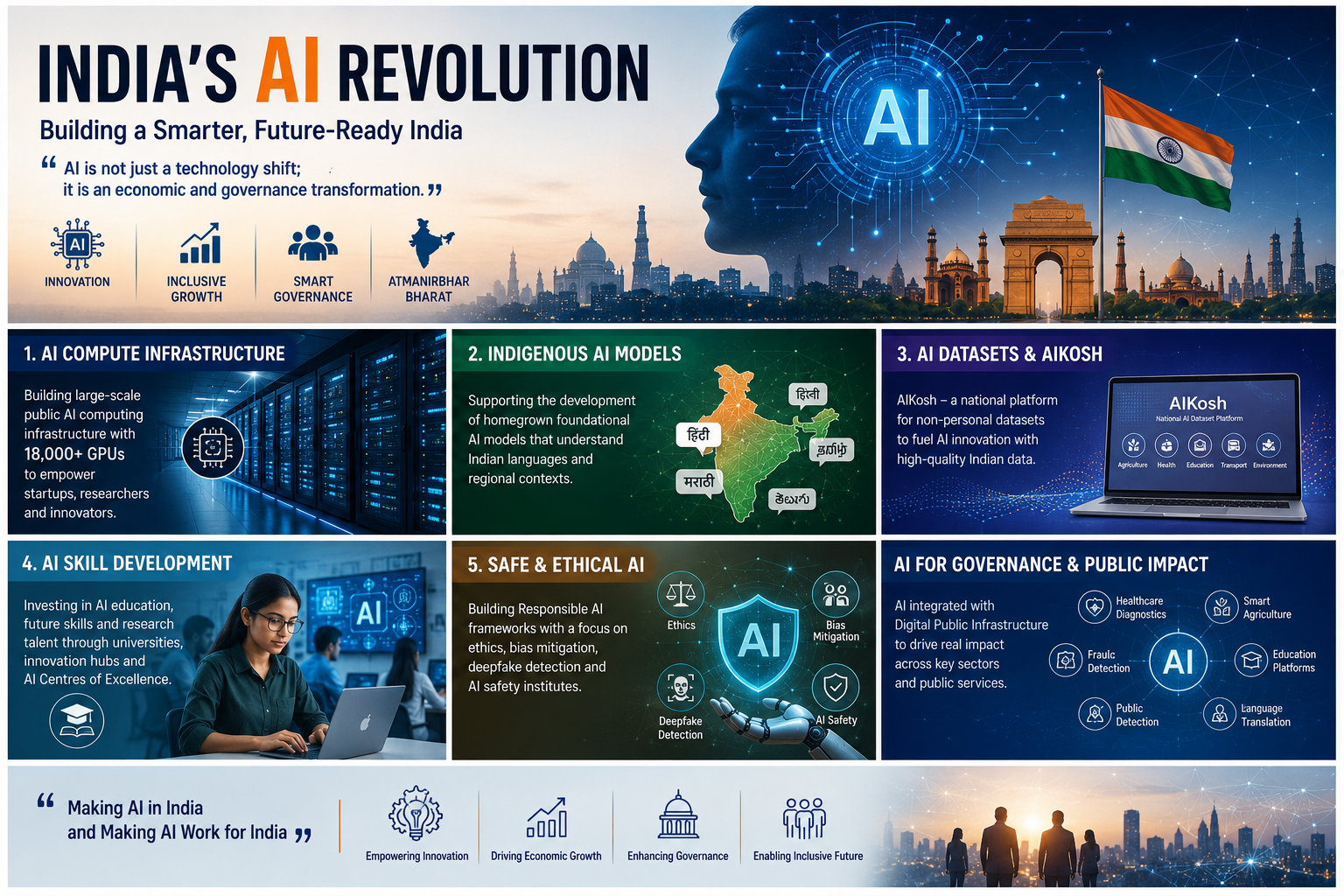

“AI is not just a technology shift; it is an economic and governance transformation.”
Artificial Intelligence is rapidly reshaping industries, governments, and economies worldwide. From healthcare and agriculture to finance and education, AI is becoming the backbone of next-generation innovation. Recognizing this global shift, the Government of India has launched an ambitious strategy to position the country as a global AI powerhouse.
The centerpiece of this strategy is the IndiaAI Mission — a nationwide initiative focused on infrastructure, innovation, talent development, responsible AI, and indigenous AI models.
Why India is Investing Aggressively in AI
India’s AI push is driven by three major goals:
- Building technological self-reliance
- Creating large-scale employment opportunities
- Making governance smarter and more efficient
The government has realized that AI will influence everything from digital public services to manufacturing competitiveness in the coming decade. To stay globally relevant alongside economies like the US and China, India is accelerating investments in AI ecosystems, compute infrastructure, and AI startups.
The IndiaAI Mission: India’s Flagship AI Program
The Government approved the IndiaAI Mission with a budget outlay of over ₹10,000 crore to strengthen the national AI ecosystem.
Key pillars of the mission include:
1. AI Compute Infrastructure
India plans to establish large-scale public AI computing infrastructure with thousands of GPUs available for startups, researchers, and developers. Recent announcements expanded this to more than 18,000 GPUs.
2. Indigenous AI Models
The government is supporting the development of homegrown foundational AI models that understand Indian languages and regional contexts. Startups like Sarvam AI are already part of this movement.
3. AI Datasets and AIKosh
India has launched AIKosh, a national platform for non-personal datasets that helps researchers and startups train AI systems using Indian data.
4. AI Skill Development
The government is investing heavily in AI education, future skills, and research talent through universities, innovation centers, and AI Centres of Excellence.
5. Safe and Ethical AI
India is also focusing on “Responsible AI” through governance frameworks, bias mitigation, deepfake detection, and AI safety institutes.
AI for Governance and Public Impact
One of India’s biggest strengths is its ability to combine AI with Digital Public Infrastructure.
The government aims to integrate AI into:
- Healthcare diagnostics
- Smart agriculture
- Education platforms
- Language translation
- Fraud detection
- Public administration
This approach focuses not just on commercial AI, but also on inclusive AI that benefits citizens at scale.
“Making AI in India and Making AI Work for India” has become the guiding vision of the national AI strategy.
Opportunities for Businesses and CEOs
For business leaders, India’s AI transformation creates major opportunities:
Faster Digital Transformation
Government-backed AI infrastructure reduces barriers for startups and enterprises adopting AI solutions.
New Market Expansion
AI adoption across sectors like agriculture, fintech, logistics, healthcare, and manufacturing opens massive untapped markets.
Startup Ecosystem Growth
India’s AI startup ecosystem is receiving policy support, compute access, and funding opportunities.
Multilingual AI Advantage
India’s focus on regional language AI could become a global differentiator for emerging-market AI products
Challenges India Still Needs to Solve
Despite strong momentum, several challenges remain:
- High-end semiconductor dependency
- AI talent shortages
- Regulatory clarity
- Data quality and accessibility
- Ethical AI governance
Industry experts have also pointed to funding and operational bottlenecks that need smoother execution.
However, the overall direction clearly signals that India intends to become a serious AI innovation hub in the coming years.
Final Thoughts
India’s AI journey is no longer experimental — it is strategic, structured, and nationally prioritized.
With investments in compute infrastructure, sovereign AI models, responsible AI frameworks, startup financing, and digital public infrastructure, the country is preparing itself for the next era of technological leadership.
For CEOs, entrepreneurs, and policymakers, this is more than a technology trend. It is a long-term transformation that will influence productivity, governance, competitiveness, and economic growth for decades.
Official Sources & References
- IndiaAI Mission
- Prime Minister of India – IndiaAI Mission Announcement
- Principal Scientific Adviser – AI Mission
- National e-Governance Division (NeGD) – IndiaAI Initiatives
- IndiaAI – Foundational AI Models Initiative
AI Disclosure: This article was generated with the assistance of Artificial Intelligence (AI). While efforts have been made to verify the information, readers are encouraged to consult the cited official sources for the latest updates.